


Page 73 - Monaco Economy 130-2
P. 73
MEB: "We have moved from an energy risk to a financial risk".


          Growth, inflation, ageing populations... Coface's chief economist Jean-Christophe Caffet decoded
          the main macroeconomic challenges ahead for the members of the Monaco Economic Board.


                                                                                                        By Milena Radoman


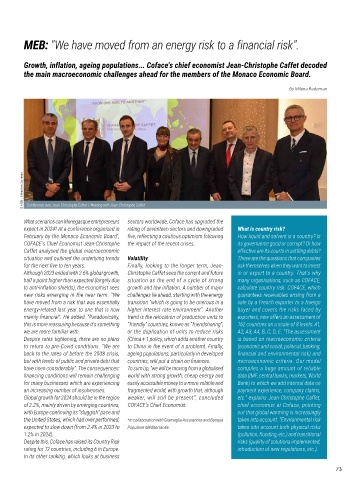
         © MEB / Sébastien Darrasse  Conférence avec Jean-Christophe Caffet / Meeting with Jean-Christophe Caffet


          What scenarios can Monegasque entrepreneurs   sectors worldwide, Coface has upgraded the
          expect in 2024? At a conference organised in   rating of seventeen sectors and downgraded   What is country risk?
          February by the Monaco Economic Board ,   five, reflecting a cautious optimism following   How liquid and solvent is a country? Is
                                           *
          COFACE's Chief Economist Jean-Christophe   the impact of the recent crises.  its governance good or corrupt? Or how
          Caffet analysed the global macroeconomic                                   effective are its courts in settling debts?
          situation and outlined the underlying trends   Volatility                  These are the questions that companies
          for the next five to ten years.     Finally, looking to the longer term, Jean-  ask themselves when they want to invest
          Although 2023 ended with 2.6% global growth,   Christophe Caffet sees the current and future   in or export to a country. That's why
          half a point higher than expected (largely due   situation as the end of a cycle of strong   many organisations, such as COFACE,
          to anti-inflation shields), the economist sees   growth and low inflation. A number of major   calculate country risk. COFACE, which
          new risks emerging in the near term. “We   challenges lie ahead, starting with the energy   guarantees receivables arising from a
          have moved from a risk that was essentially   transition “which is going to be onerous in a   sale by a French exporter to a foreign
          energy-related last year to one that is now   higher interest rate environment”. Another   buyer and covers the risks faced by
          mainly financial”. He added: “Paradoxically,   trend is the relocation of production units to   exporters, now offers an assessment of
          this is more reassuring because it's something   “friendly” countries, known as “friendshoring”,   162 countries on a scale of 8 levels: A1,
          we are more familiar with.          or the duplication of units to reduce risks   A2, A3, A4, B, C, D, E. “The assessment
          Despite rates tightening, there are no plans   (China + 1 policy, which adds another country   is based on macroeconomic criteria
          to return to pre-Covid conditions. “We are   to China in the event of a problem). Finally,   (economic and social, political, banking,
          back to the rates of before the 2008 crisis,   ageing populations, particularly in developed   financial and environmental risk) and
          but with levels of public and private debt that   countries, will put a strain on finances.   microeconomic criteria. Our model
          have risen considerably”. The consequences:   To sum up, “we will be moving from a globalised   compiles a huge amount of reliable
          financing conditions will remain challenging   world with strong growth, cheap energy and   data (IMF, central banks, markets, World
          for many businesses which are experiencing   easily accessible money to a more volatile and   Bank) to which we add internal data on
          an increasing number of insolvencies.  fragmented world, with growth that, although   payment experience, company claims,
          Global growth for 2024 should be in the region   weaker, will still be present”, concluded   etc.” explains Jean-Christophe Caffet,
          of 2.2%, mainly driven by emerging countries,   COFACE's Chief Economist.  chief economist at Coface, pointing
          with Europe continuing its “sluggish” pace and                             out that global warming is increasingly
          the United States, which had over performed,   *in collaboration with Gramaglia Assurances and Banque   taken into account. “Environmental risk
          expected to slow down (from 2.4% in 2023 to   Populaire Méditerranée.      takes into account both physical risks
          1.2% in 2024).                                                             (pollution, flooding, etc.) and transitional
          Despite this, Coface has raised its Country Risk                           risks (quality of solutions implemented,
          rating for 12 countries, including 6 in Europe.                            introduction of new regulations, etc.).
          In its other ranking, which looks at business

                                                                                                                        73

