


Page 96 - Monaco Economy 129
P. 96
CÔTE D'AZUR


          La future grande gare de Nice dévoilée                                                            par M. Berger


          Annoncée comme la première gare bioclimatique d'Europe, la future gare centrale de la métropole
          Nice Côte d’Azur est attendue pour la fin de l’année 2028. Le coût des travaux pour transformer
          la gare TER actuelle, mise en service en septembre 2022 depuis la fermeture de la gare SNCF
          Saint-Augustin, est estimé à 232 millions d’euros.


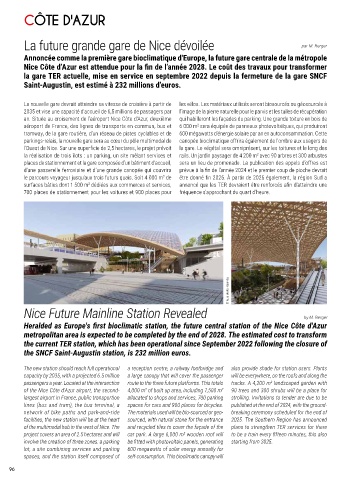
          La nouvelle gare devrait atteindre sa vitesse de croisière à partir de   les vélos. Les matériaux utilisés seront biosourcés ou géosourcés à
          2035 et vise une capacité d'accueil de 6,5 millions de passagers par   l'image de la pierre naturelle pour le parvis et les tuiles de récupération
          an. Située au croisement de l’aéroport Nice Côte d’Azur, deuxième   qui habilleront les façades du parking. Une grande toiture en bois de
          aéroport de France, des lignes de transports en commun, bus et   6 000 m  sera équipée de panneaux photovoltaïques, qui produiront
                                                                       2
          tramway, de la gare routière, d’un réseau de pistes cyclables et de   600 mégawatts d’énergie solaire par an en autoconsommation. Cette
          parkings-relais, la nouvelle gare sera au cœur du pôle multimodal de   canopée bioclimatique offrira également de l'ombre aux usagers de
          l’Ouest de Nice. Sur une superficie de 2,5 hectares, le projet prévoit   la gare. Le végétal sera omniprésent, sur les toitures et le long des
          la réalisation de trois îlots : un parking, un site mêlant services et   rails. Un jardin paysager de 4 200 m  avec 90 arbres et 300 arbustes
                                                                                            2
          places de stationnement et la gare composée d’un bâtiment d’accueil,   sera un lieu de promenade. La publication des appels d’offres est
          d’une passerelle ferroviaire et d’une grande canopée qui couvrira   prévue à la fin de l’année 2024 et le premier coup de pioche devrait
         le parcours voyageur jusqu’aux trois futurs quais. Soit 4 000 m  de   être donné fin 2025. À partir de 2025 également, la région Sud a
                                                           2
          surfaces bâties dont 1 500 m  dédiées aux commerces et services,   annoncé que les TER devraient être renforcés afin d'atteindre une
                                2
          700 places de stationnement pour les voitures et 900 places pour   fréquence s'approchant du quart d'heure.


                                                                                  © tous droits réservés


          Nice Future Mainline Station Revealed                                                              by M. Berger


          Heralded as Europe's first bioclimatic station, the future central station of the Nice Côte d'Azur
          metropolitan area is expected to be completed by the end of 2028. The estimated cost to transform
          the current TER station, which has been operational since September 2022 following the closure of
          the SNCF Saint-Augustin station, is 232 million euros.


          The new station should reach full operational   a reception centre, a railway footbridge and   also provide shade for station users. Plants
          capacity by 2035, with a projected 6.5 million   a large canopy that will cover the passenger   will be everywhere, on the roofs and along the
          passengers a year. Located at the intersection   route to the three future platforms. This totals   tracks. A 4,200 m  landscaped garden with
                                                                                                 2
          of the Nice Côte d'Azur airport, the second-  4,000 m  of built up area, including 1,500 m    90 trees and 300 shrubs will be a place for
                                                     2
                                                                                2
          largest airport in France, public transportion   allocated to shops and services, 700 parking   strolling. Invitations to tender are due to be
          lines (bus and tram), the bus terminal, a   spaces for cars and 900 places for bicycles.   published at the end of 2024, with the ground-
          network of bike paths and park-and-ride   The materials used will be bio-sourced or geo-  breaking ceremony scheduled for the end of
          facilities, the new station will be at the heart   sourced, with natural stone for the entrance   2025. The Southern Region has announced
          of the multimodal hub in the west of Nice. The   and recycled tiles to cover the façade of the   plans to strengthen TER services for there
          project covers an area of 2.5 hectares and will   car park. A large 6,000 m  wooden roof will   to be a train every fifteen minutes, this also
                                                                  2
          involve the creation of three zones: a parking   be fitted with photovoltaic panels, generating   starting from 2025.
          lot, a site combining services and parking   600 megawatts of solar energy annually for
          spaces, and the station itself composed of   self-consumption. This bioclimatic canopy will

    96

