


Page 130 - Monaco Economy 120
P. 130
ZOOM


              Another turning point?
              Education in 2050 will also benefit from
              the contributions of digital technology and
              advances in architecture to offer a greater
              variety of spaces for learning. The classroom
              will not disappear but its organisation will be
              more flexible so that it can be modified to
              adapt to what the students have to learn and
              how they have to learn (alone, in pairs or in
              groups . Digital technology will undoubtedly
              make it possible to make the time before,
              during and after class more coherent.
              Teaching can thus be done before going to
              class, thanks to the flipped classroom model.
              At home, students who have difficulty doing
              their homework or revising for a test can
              also question their teacher or be helped by a
              tutor. The student will, therefore, have greater                                                               © Michael Alesi / Direction de la communication
              continuity of learning throughout the week.
              Team projects will also gain momentum
              because they allow the acquisition of the
              skills necessary for the professions of 2050:
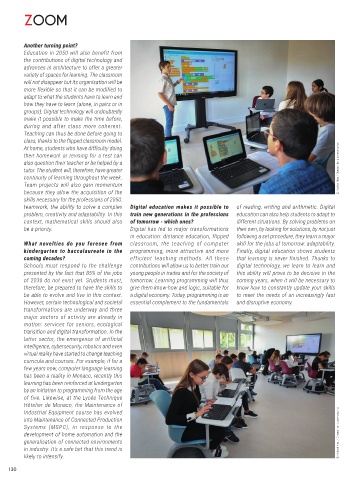
              teamwork, the ability to solve a complex   Digital education makes it possible to   of reading, writing and arithmetic. Digital
              problem, creativity and adaptability. In this   train new generations in the professions   education can also help students to adapt to
              context, mathematical skills should also   of tomorrow - which ones        different situations. By solving problems on
              be a priority.                       Digital has led to major transformations   their own, by looking for solutions, by not just
                                                   in education: distance education, flipped   following a set procedure, they learn a major
               hat  novelties  do  you  foresee  from   classroom,  the  teaching  of  computer   skill for the jobs of tomorrow: adaptability.
              kindergarten  to  baccalaureate  in  the   programming, more attractive and more   Finally, digital education shows students
              coming decades                       efficient  teaching  methods.  All  these   that learning is never finished. Thanks to
              Schools must respond to the challenge   contributions will allow us to better train our   digital technology, we learn to learn and
              presented by the fact that 85% of the jobs   young people in trades and for the society of   this ability will prove to be decisive in the
              of 2030 do not exist yet. Students must,   tomorrow.  earning programming will thus   coming years, when it will be necessary to
              therefore, be prepared to have the skills to   give them know-how and logic, suitable for   know how to constantly update your skills
              be able to evolve and live in this context.   a digital economy. Today, programming is an   to meet the needs of an increasingly fast
              However, certain technological and societal   essential complement to the fundamentals   and disruptive economy.
              transformations are underway and three
              major sectors of activity are already in
              motion: services for seniors, ecological
              transition and digital transformation. In the
              latter sector, the emergence of artificial
              intelligence, cybersecurity, robotics and even
              virtual reality have started to change teaching
              curricula and courses. For example, if for a
              few years now, computer language learning                                                                                RITA ACKERMANN
              has been a reality in Monaco, recently this
              learning has been reinforced at kindergarten                                                                             MAMA ‘2
              by an initiation to programming from the age
              of five.  ikewise, at the  ycée Technique
              Hôtelier de Monaco, the Maintenance of                                                                                   8 OCTOBER   23 DECEMBER 202
              Industrial Equipment course has evolved
              into Maintenance of Connected Production                                                                                 ONE MONTE CARLO, MONACO
              Systems  (MSPC ,  in  response  to  the
              development of home automation and the                                                                         © Michael Alesi / Direction de la communication
              generalisation of connected environments                                                                                 WWW.HAUSERWIRTH.COM
              in industry. It’s a safe bet that this trend is
              likely to intensify.

        130


                                                                                                                                    01172021014_HWMN_220x330_Ackermann_MonacoEconomie_V2.indd   1                                                    24.09.21   16:41

