


Page 15 - ME_132_web
P. 15
the seafront. ‘‘These projects were, and still   constructed  on  the  4  reclaimed  hectares.   Exploiting the Principality's limitations means
          are, true technical achievements: the Larvotto   All of these construction programmes have   that travel can be carried out underground.
          artificial beach was the first to be created in the   profoundly  changed  the  layout  of  Monaco.   "Every day, the Principality doubles its
          Mediterranean, and its protective structures   "Today,  underground  Monaco  represents   population with the arrival of tourists and
          have proved remarkably effective for over 50   more  than  3.5  million  m  of infrastructure,   commuters. To absorb this inflow - often by car
                                                                  3
          years, requiring very little maintenance; the   in short, a State under the State" comments   - we need to offer an adequate supply of public
          Spélugues complex overlooks two major traffic   Jean-Philippe Hugron. It all stems from the   car parks (to date, more than 15,000 spaces
          arteries in the Principality and rests partly on   fact that “the  Principality  needs space  for   are available in 40 different car parks) and to
          piers above the sea; the Grimaldi Forum is   less lucrative activities, as well for facilities   avoid congestion on the city's main roads"
          built two-thirds below sea level, to a depth   and  infrastructures  that  are  necessary  to   the specialist explains, before adding: “Six
          of -20 metres, and has a permanent pumping   keep  the  city  running  smoothly:  sewage   kilometres of underground tunnels also ensure
          system to ensure the building's stability against   treatment,  refuse  processing,  parking  and   the automated collection of household waste,
          hydrostatic pressure’’ he explains.  storage  of all  kinds". So, in  the  eyes  of   transported at a speed of 70 km/h directly into
          The largest extension out to sea (22 hectares)   town planners and developers, Monaco has   the incineration plant, which, as part of a policy
          was constructed at Fontvieille. The area   another, equally invisible reserve: a deposit   of ‘‘waste recovery’’, helps to produce energy, in
          took more than 30 years to develop, until the   of space... underground.  particular for the Principality's urban heating”.
          Fontvieille Shopping Centre was completed
          in 1993, followed by the latest housing
          development in 2000. At the same time, Port
          Hercule underwent another expansion with
          the arrival of the semi-floating seawall (a
          structure weighing 160,000 tonnes, 352 m
          long, 28 m wide and 19 m high!) attached to
          a new quay. This meant extending the site
          by 3.7 hectares.
          At the end of the 2000s, plans for an offshore
          extension resurfaced. Monaco requires
          between 300,000 - 350,000 m² per decade
          to meet its needs... Although the project for
          a 17-hectare district reclaimed from the sea
          (the result of an international competition)
          collapsed with the financial crisis of 2008,
          Mareterra is coming to life. Designed as an
          extension of the existing coastline, from the
          Grimaldi Forum to the Formula 1 Grand Prix
          tunnel, ‘‘Mareterra will integrate perfectly with
          our coastline and in a few years’ time will be
          seen as a natural extension of our territory,’’
          predicts Prince Albert II.

          Monaco Underground

          In the past, Monaco has also gained precious
          square metres underground. Notably with the
          construction of an underground railway line,
          which began in the early 1960s before being
          resumed at the end of the 1990s, resulting
          in transferring the train station to the deep
          valley of Sainte-Dévote (with a 13-level car
          park)... But above all with the urbanisation of
          the land that was consequently abandoned
          by the SNCF. From 1999 onwards, the new
          underground railway line in Monaco has
          enabled a vast urban renewal operation: the
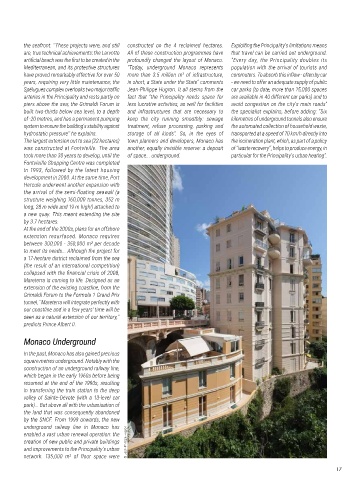
          creation of new public and private buildings  © Jean-Philippe Hugron
          and improvements to the Principality's urban
          network. 135,000  m² of floor space were

                                                                                                                        17

