


Page 91 - Monaco Economy 131
P. 91
PERCEPTION                                                                                    by Suzanne Belaieff

          SPACE EXPERIENCE                                                                                             PUBLI-COMMUNIQUÉ


          SPACE “on foot” has attracted architects, urban planners and landscape architects in particular.
          The place given to humans by urban spaces.
          A seemingly banal and insignificant stroll should be taken attentively.
          Over and above the different approaches, these projects are all part of the same quest
          for “what makes sense in a particular space”, as we find meaning in the space,
          which is not a specific feature of a physical form as it may be “described in
          a drawing and an outline”, but as it appears to the person who inhabits it
          and walks through it.
          Perception and its meaning, that is to say its meaning on a social and
          cultural level: we can even describe what the world of “feeling” is,
          being endowed with movement “acts” relating to space, so it’s through
          movement that we form our non-verbal thought, this is how space is
          acquired; this is how the world around makes “sense” to me.
          Consciousness is originally not an I THINK, but an I CAN.
          Consequently, it is as a being who perceives, feels and is capable
          of opening up that we experience the world, and as a result, give it
          meaning, “meaning” that is thus reinterpreted by accompanying the
          subject towards a self-determined goal.”

          “Sense of movement” requires the brain to reconstruct the movement
          of the body and the environment in a coherent way.

          To speak of perception by separating the senses no longer makes sense.
          Perception must be understood as “an attitude, a preparation for the act”.
          The act of interacting with the world “becomes the organiser of
          perception or of the perceived world.”
          The walk is a “sense-making act” that requires the skill of the person
          who is walking.
          The text is read “step by step”.
          The written space, like the text, is there waiting for its reader.
          Such an approach opens the door to aesthetic appreciation, as in the
          example of a simple intersection of paths that we have to walk on.
          Perpetual, motorised decisions are so many moments of dialogue
          between the space and the walker; the work of Art then obtains the
          perception it solicits and deserves.
          Perceiving architecture and the city is part of our permanent daily
          lives; we live in architectural and urban spaces that we use in a routine
          manner which leads us to frequent spaces according to our needs; we
          are engaged in this relationship with architecture and the city, and we
          have access to these perceptions; they accompany us and enable us
          to act in a space.


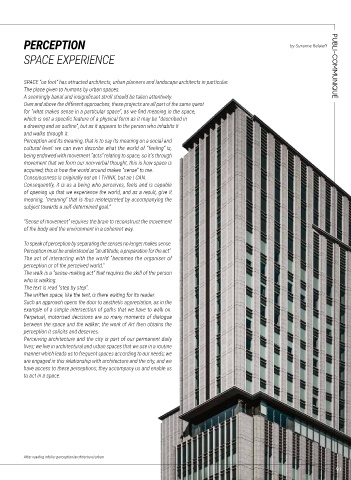
          After reading infolio: perception/architecture/urban

                                                                                                                        91
                                                                                                                        91

