


Page 42 - Monaco Economy 129
P. 42
ZOOM


          PHOENIX CONSULTING: What would happen if Monaco were

          placed on the FATF grey list?                                                                 By Milena Radoman


          Impact on the private sector, consequences on GDP, drop in investments... In a study, the Phoenix
          Consulting firm quantified the economic consequences of a much-feared scenario in countries
          placed on the grey list.


          The classification of a country on the FATF   a significant drop in foreign investment after   Decline in GDP of the country concerned
          grey list is not trivial. Beyond harming its   being greylisted in 2011; it was de-listed 2014,   More worrying, according to a report by the
          image, there are numerous repercussions   then relisted in 2021. “Foreign direct investment   International Monetary Fund, a move to the
          for a country’s economy, starting with a   fell from $19 billion to $5.7 billion between 2007   grey list can have a significant negative impact
          potential drop in GDP. This is what the study by   and 2020, whilst bonds held by foreigners fell   on a country’s GDP, specially if that country
          Sébastien Prat, partner at Phoenix Consulting   from 25% in 2016 to around 5% in 2021.”  remains on the grey list for a prolonged period.
          Monaco and Secretary General of the Monaco                               Between 2008 and 2019, Pakistan’s move to
          Association of Compliance Officers (AMCO)   Decline in the number of banking   the grey list led to a drop in its GDP of up to
          concludes: “The initial objective of the inclusion   correspondents      4% per year.
          of a country on this list is to encourage it to   “Banking and financial institutions feel the   “The economic contexts of Pakistan and
          comply more with FATF standards, thus having   most significant impact, with a decrease in   Monaco differ significantly. For example, the
          a strong economic impact,” he summarises.   the number of correspondent banks, even   financial sector, which is particularly affected
          The FATF uses the ‘name and shame’ process   before greylisting. Malta recorded a 20%   when a country is placed on the grey list, only
          to bring about important and necessary   drop in the number of Correspondent Banking   represents around 4% of GDP in Pakistan,
          reforms. “According to the FATF, a move to   Relationships (CBRs) between 2011 and   whilst it constitutes more than 16% of GDP in
          the grey list could indeed result in higher   2019. For example, the Bank of Valletta   Monaco. The repercussions on the GDP of a
          costs for the international trading partners of   (BOV), the leading Maltese bank, lost all of its   jurisdiction like Monaco would therefore be
          the country in question, due to the additional   correspondent banks for transactions in US   much greater than those observed in Pakistan,”
          measures imposed, or even completely deprive   dollars just before Malta moved to the grey list.”  judges Sébastien Prat.
          them of the possibility of doing business with
          that country.”

          The “de-risking” phenomenon            Short-term impacts for the private sector
          First  consequence:  “ de-risking”  is  a   One of the main fears of the private sector is this: the
          phenomenon which sees foreign financial   increase in compliance costs for regulated professionals.
          institutions distancing themselves from   It is important and manifests itself at several levels,
          counterparties, banking correspondents,   as the Phoenix Consulting study shows, starting with
          clients or countries considered to present   operational costs (in particular the recruitment of
          high risks in terms of money laundering or   qualified personnel).
          the financing of terrorism. “The high costs   Thus, “In 2021, HSBC Malta’s costs increased by more
          of compliance, reputational risk and the   than 10%, due to the strengthening of controls on
          complexity of transactions are all factors that   customers and operations and the investment in new
          push financial institutions to avoid dealing   digital tools (KYC, ERP, screening). Similar cost increases are observed amongst all
          with countries deemed to be at risk,” notes   regulated professionals, including the major Maltese banks.”
          Sébastien Prat. The impact is tangible on   Added to this is the investment in technological solutions, the reputational cost
          cross-border payments. According to a 2016   (communication campaigns, internal awareness-raising, setting up extra-financial
          study by the Centre for Global Development,   reports etc) but also the cost of transactions and operations. “Companies from listed
          “Greylisting results in an average 7-10% drop   countries face another problem: transactions become more complex when dealing
          in inbound payments to greylisted countries.”  with foreign partners, leading to a possible alteration of international relations. Local
                                                 operations also become more time-consuming and costly due to tighter controls over
          Drop in foreign investment             customers and operations and this, in turn, lengthens lead times and increases costs
          Another phenomenon: “A move to the grey list   associated with transactions. Some companies located in non-listed countries even
          can also discourage foreign investors in these   choose to refuse to collaborate with entities based in greylisted countries,” indicates
          regions, who then see the move to the grey list   Sébastien Prat – not to mention the cost of sanctions: “In Malta, we observe that the
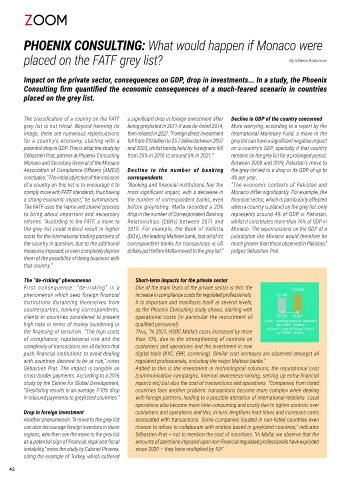
          as a potential sign of financial, legal and fiscal   amounts of sanctions imposed upon non-financial regulated professionals have exploded
          instability,” notes the study by Cabinet Phoenix,   since 2020 – they have multiplied by 53!”
          citing the example of Turkey, which suffered

    42

