


Page 105 - Monaco Economie 126
P. 105
TOURISTS at home with the LOCALS                                                              by Suzanne Belaieff


              Economic, sociological and political relations   Many private and voluntary players work   those passing through and those who
              between residents and tourists are linked to   together to this end; tourism can be at the   stay come up against broader problems
              their activities, specifically as far as the the   forefront of projects with more global impact   of cohabitation between “consuming” and
              property market is concerned.        “tourism strategy that has been thought   “enjoying” and “living and working” in a
              Indeed, it is essential to make public the   up outside the box becomes a catalyst for   context where the levels and players are
              conflicting interests of those planning to   local projects!             both different and disparate.
              acquire land. In fact, it is a question of   As for the tourists: the movement, the   “If the locals have long been the “poor cousins,”
              designing something welcoming and pleasant   experience, rootedness, habit, the idea   thought of as second-class citizens in relation
              to live in on a daily basis for the different   being to break free from being locked into a   to the tourist development rationale, the
              times of the year, where everything functions   mono-identity so as to understand the local   tourism directors are increasingly appealing
              in a binary mode with spacetime positioning   lifestyle, even when the conflicts or different   to the residents to participate in their
              within the communities - temporary residents   appropriations of the area between tourists   promotion.
              and permanent residents: “The more touristy   and locals are perpetuated or redefined.v  Tourism is becoming one of the fastest
              a place is, the higher the price of real estate…”.                       growing sectors. The livelihood of a large
                                                   Is it possible to have a public policy that   number of inhabitants is dependent on
              Yet accommodation designed specifically for   meets the needs of all?    tourist spending. While heritage is about
              tourists can make the area more attractive.  Is the answer to management needs of all   preservation, tourism is about change.
              In addition to the resident population, there   both ephemeral and permanent?
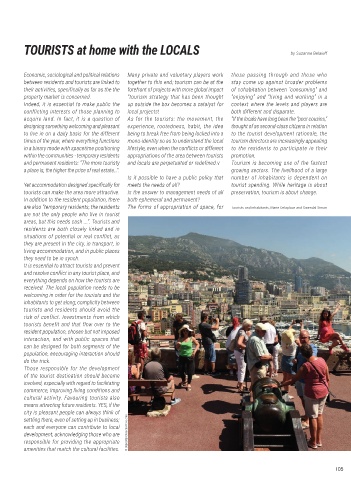
              are also “temporary residents; the residents   The forms of appropriation of space, for   Tourists and inhabitants, Marie Delaplace and Gwendal Simon
              are not the only people who live in tourist
              areas, but this needs cash ...”. Tourists and
              residents are both closely linked and in
              situations of potential or real conflict, as
              they are present in the city, in transport, in
              living accommodation, and in public places
              they need to be in synch.
              It is essential to attract tourists and prevent
              and resolve conflict in any tourist place, and
              everything depends on how the tourists are
              received. The local population needs to be
              welcoming in order for the tourists and the
              inhabitants to get along; complicity between
              tourists and residents should avoid the
              risk of conflict. Investments from which
              tourists benefit and that flow over to the
              resident population, chosen but not imposed
              interaction, and with public spaces that
              can be designed for both segments of the
              population, encouraging interaction should
              do the trick.
              Those responsible for the development
              of the tourist destination should become
              involved, especially with regard to facilitating
              commerce, improving living conditions and
              cultural activity. Favouring tourists also
              means attracting future residents. YES, if the
              city is pleasant people can always think of
              settling there, even of setting up in business;
              each and everyone can contribute to local
              development, acknowledging those who are  © depositphotos/Bumble-Dee
              responsible for providing the appropriate
              amenities that match the cultural facilities.


                                                                                                                            105


       ME_126.indd   105                                                                                               13/04/2023   11:33

