


Page 97 - Monaco Economy 131
P. 97
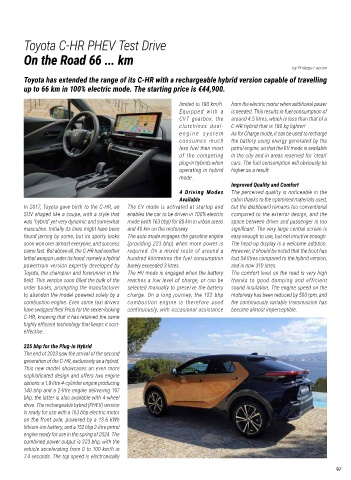
Toyota C-HR PHEV Test Drive

          On the Road 66 ... km

                                                                                                         by Philippe Lacroix
          Toyota has extended the range of its C-HR with a rechargeable hybrid version capable of travelling
          up to 66 km in 100% electric mode. The starting price is €44,900.


                                                                 limited to 180 km/h.   from the electric motor when additional power
                                                                 Equipped with a   is needed. This results in fuel consumption of
                                                                 CVT  gearbox,  the   around 4.5 litres, which is less than that of a
                                                                 clutchless dual-  C-HR hybrid that is 180 kg lighter!
                                                                 e n g i n e  sy s te m   As for Charge mode, it can be used to recharge
                                                                 consumes much     the battery using energy generated by the
                                                                 less fuel than most   petrol engine, so that the EV mode is available
                                                                 of  the  competing   in the city and in areas reserved for ‘clean’
                                                                 plug-in hybrids when   cars. The fuel consumption will obviously be
                                                                 operating in hybrid   higher as a result.
                                                                 mode.
                                                                                   Improved Quality and Comfort
                                                                 4  Driving  Modes   The perceived quality is noticeable in the
                                                                 Available         cabin thanks to the optimised materials used,
          In 2017, Toyota gave birth to the C-HR, an   The EV mode is activated at startup and   but the dashboard remains too conventional
          SUV shaped like a coupe, with a style that   enables the car to be driven in 100% electric   compared to the exterior design, and the
          was ‘hybrid’ yet very dynamic and somewhat   mode (with 163 bhp) for 80 km in urban areas   space between driver and passenger is too
          masculine. Initially its lines might have been   and 40 km on the motorway.  significant. The very large central screen is
          found jarring by some, but its sporty looks   The auto mode engages the gasoline engine   easy enough to use, but not intuitive enough.
          soon won over almost everyone, and success   (providing 223 bhp) when more power is   The head-up display is a welcome addition.
          came fast. But above all, the C-HR had another   required. On a mixed route of around a   However, it should be noted that the boot has
          lethal weapon under its hood: namely a hybrid   hundred kilometres the fuel consumption   lost 54 litres compared to the hybrid version,
          powertrain version expertly developed by   barely exceeded 3 litres.     and is now 310 litres.
          Toyota, the champion and forerunner in the   The HV mode is engaged when the battery   The comfort level on the road is very high
          field. This version soon filled the bulk of the   reaches a low level of charge, or can be   thanks  to  good  damping  and  efficient
          order books, prompting the manufacturer   selected manually to preserve the battery   sound insulation. The engine speed on the
          to abandon the model powered solely by a   charge. On a long journey, the 152 bhp   motorway has been reduced by 500 rpm, and
          combustion engine. Even some taxi drivers   combustion  engine  is  therefore  used   the continuously variable transmission has
          have swapped their Prius for the sexier-looking   continuously, with occasional assistance   become almost imperceptible.
          C-HR, knowing that it has retained the same
          highly efficient technology that keeps it cost-
          effective.


          225 bhp for the Plug-in Hybrid
          The end of 2023 saw the arrival of the second
          generation of the C-HR, exclusively as a hybrid.
          This new model showcases an even more
          sophisticated design and offers two engine
          options: a 1.8 litre 4-cylinder engine producing
          140 bhp and a 2-litre engine delivering 197
          bhp, the latter is also available with 4-wheel
          drive. The rechargeable hybrid (PHEV) version
          is ready for use with a 163 bhp electric motor
          on the front axle, powered by a 13.6 kWh
          lithium-ion battery, and a 152 bhp 2-litre petrol
          engine ready for use in the spring of 2024. The
          combined power output is 223 bhp, with the
          vehicle accelerating from 0 to 100 km/h in
          7.4 seconds. The top speed is electronically

                                                                                                                        97

